

Manage cookie settings

L4 in Poland: What It Is and How Sick Leave Works
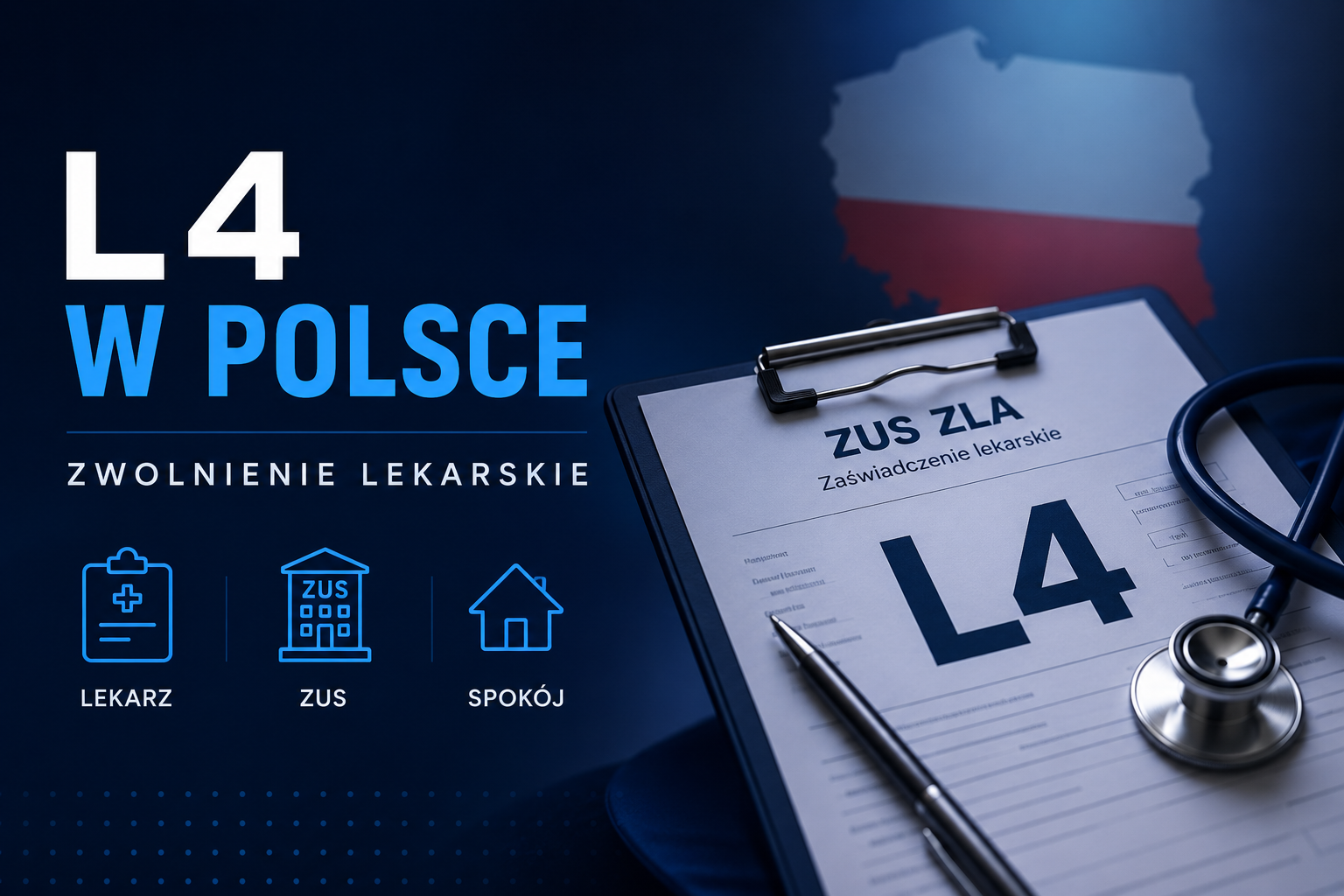
"L4 in Poland" is the common name for a medical certificate confirming temporary incapacity for work. Officially the document is called "e-ZLA" — an electronic sick leave certificate. It is issued by a doctor when a patient's state of health does not allow them to work.
L4 confirms that an employee's absence from work is lawful and, provided the statutory conditions are met, gives entitlement to "sick pay in Poland".
How to get L4 in Poland
To obtain sick leave you need to see a doctor and undergo a medical consultation. An electronic e-ZLA certificate can be issued by a family doctor, a specialist, a hospital physician or a dentist. The decision on temporary incapacity for work takes into account the patient's condition, the illness itself and the nature of the work performed.
Once "e-ZLA in Poland" has been issued, the document goes automatically to the ZUS system and to the employer's electronic profile on PUE/eZUS. As a rule the employee does not need to hand over a paper certificate, but should notify the employer of the absence in good time.
If the employer has no PUE/eZUS profile, the doctor issues a printout of the e-ZLA. The employee then has to deliver it to the employer personally.
Who is entitled to paid sick leave in Poland
Entitlement to paid L4 depends not on the employee's citizenship but on being covered by sickness insurance — "ubezpieczenie chorobowe".
Under an employment contract ("umowa o pracę") sickness insurance is compulsory. Under a contract of mandate ("umowa zlecenie") it is usually voluntary. Before taking L4, therefore, check whether the principal has actually registered you for voluntary insurance and whether the sickness contribution ("składka chorobowa") is being paid.
With compulsory insurance, entitlement to benefit generally arises after 30 days of uninterrupted insurance cover. With voluntary insurance the waiting period is 90 days. The law provides for a number of exceptions, so an individual situation should be verified against ZUS records.
Who pays for L4: the employer or ZUS
For the first 33 calendar days of illness in a given year, the employee receives "wynagrodzenie chorobowe" — sick pay financed by the employer.
For employees over 50 this period is 14 days, starting from the calendar year following the year in which the employee turned 50.
From day 34 of incapacity — or from day 15 for the age group above — "zasiłek chorobowy" (sickness benefit) is paid from the Social Insurance Fund. The payment itself may be transferred either by the employer or directly by ZUS, depending on how many insured employees the contribution payer has.
How much you get on sick leave in Poland
Standard "sick leave pay in Poland" amounts to 80% of the calculation base. This is not always exactly 80% of the salary the employee usually takes home.
For an employee, the base is most often calculated from the average remuneration over the 12 calendar months preceding the month in which the illness began. Statutory social security contributions are deducted from that figure.
The benefit is paid at 100% of the base in cases including:
- incapacity for work occurring during pregnancy;
- an accident on the way to or from work;
- examinations and medical procedures related to the donation of cells, tissues or organs.
How long you can stay on L4
The standard maximum period for receiving sickness benefit is 182 days. In cases of tuberculosis, or incapacity for work during pregnancy, it may be extended to 270 days.
Earlier periods of sick leave may be counted towards a single benefit period if the break between them did not exceed 60 days. Issuing a new e-ZLA therefore does not always mean that a new limit begins.
What you can and cannot do during L4
Sick leave is intended for treatment and recovery. During L4 it is prohibited to perform paid work or to engage in any activity that could delay recovery.
From 13 April 2026, Polish rules draw a clearer line between misuse of sick leave and ordinary everyday activities. Necessary day-to-day matters and isolated actions prompted by important circumstances are permitted, provided they do not conflict with the purpose of the sick leave.
ZUS or the employer may check whether the leave is being used correctly. Working during L4, or any activity that interferes with treatment, can lead to loss of benefit for the entire period under review.
L4 for foreigners in Poland
Foreign employees receive sick leave on the same insurance terms as everyone else. What matters is legal employment, registration with ZUS and being covered by "ubezpieczenie chorobowe".
Before signing a umowa zlecenie it is worth confirming whether voluntary sickness insurance has been arranged. Without it, an electronic certificate will confirm the incapacity for work, but there may be no entitlement to zasiłek chorobowy.
Conclusion
"L4 in Poland" protects employees during illness, but it requires the formalities and the treatment regime to be observed. Check your type of contract, your insurance status and the address of stay given in the e-ZLA in order to avoid a delayed or refused payment.